

As a VC who’s spent years tracking enterprise infrastructure plays, I’ve seen my share of “sustainability theater” – companies making grand environmental promises while their actual operations tell a different story. But Amazon’s recent partnership with Molg represents something genuinely different: a convergence of economic necessity and environmental responsibility that creates real alpha.
The $62 Billion Problem Hiding in Plain Sight
Here’s a stat that should make every infrastructure investor pause: globally, we generate the fastest-growing waste stream in the form of electronic waste, yet only 22% gets recycled. The UN estimates we’re literally burying $62 billion worth of recoverable materials annually. That’s not just an environmental tragedy – it’s a massive market inefficiency screaming for disruption.
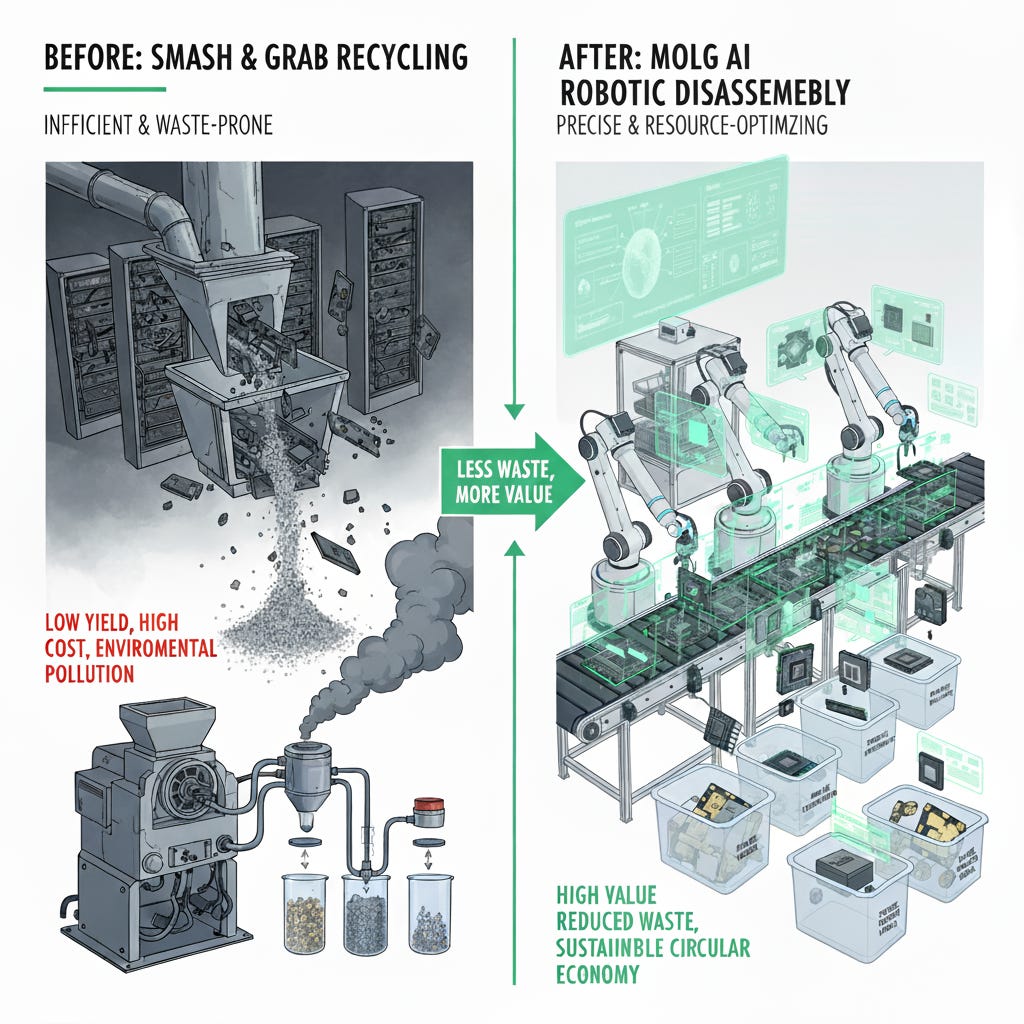
For hyperscale operators like Amazon, this isn’t theoretical. They’re running hundreds of AWS data centers globally, with server refresh cycles every 5-6 years. The traditional approach? What the industry calls “smash and grab” – essentially destroying equipment and selling it as scrap metal. It’s primitive, wasteful, and increasingly expensive.
Why Amazon Wrote a $10M Check to Molg
Amazon’s investment in Molg’s Series A wasn’t charity. It was strategic necessity wrapped in an ESG bow. The company committed to net-zero carbon emissions by 2040, then watched their carbon footprint increase 6% last year as AI demand exploded. Something had to give.
Molg’s solution is elegantly simple: deploy AI-powered robots that can intelligently assess, test, and disassemble electronic components. Instead of destroying everything, these systems identify what’s still functional, what can be refurbished, and what should be recycled. It’s precision demolition meets circular economy.
The Virginia-based startup has installed these systems at Amazon’s re:Cycle Reverse Logistics facility in Pennsylvania, where robots now handle servers and hard drives with surgical precision. The results speak to the business case: Amazon sourced 16% of its data center components from internal refurbished inventory last year, extending component lifecycles by 1-2 years.
The Investment Thesis Writes Itself
From a pure financial perspective, this is a no-brainer. You’re simultaneously reducing procurement costs (buying fewer new components), decreasing disposal expenses, and potentially creating new revenue streams from refurbished equipment sales. The unit economics improve across multiple vectors.
But the real opportunity lies in scalability. Molg is a 35-person company founded in 2021, currently producing robots at “dozens” scale. Yet they’re already expanding to Kentucky, Dublin, and Singapore with Amazon. The addressable market? Roughly 10,000 data centers globally, all facing identical challenges.
The competitive moat is surprisingly wide. Very few companies are building automated e-waste processing solutions at enterprise scale. Molg also secured a $6.5M Department of Energy grant to develop laptop disassembly capabilities, proving the technology’s adaptability across device categories.
Beyond the Green Washing
What excites me most about this investment isn’t the sustainability angle – it’s the fundamental business model innovation. Traditional e-waste processing is labor-intensive and geographically constrained. Molg’s approach is capital-intensive upfront but scales beautifully, with AI models that improve over time and apply across device types.
CEO Rob Rawson-Shanks frames it perfectly: “How do we redeploy this equipment at the highest value?” It’s asset optimization through intelligent automation, with environmental benefits as a valuable byproduct rather than the primary driver.
The Bigger Picture for VCs
This deal exemplifies a broader trend I’m tracking: the convergence of operational efficiency and environmental responsibility creating genuine investment opportunities. The old binary thinking – profit versus planet – is becoming obsolete as technology enables solutions that optimize for both.
For early-stage investors, the lesson is clear: look for companies solving real operational problems that happen to have positive environmental externalities. The sustainability narrative helps with enterprise sales and regulatory compliance, but the core value proposition must stand on pure economics.
Amazon’s willingness to invest and expand this partnership validates both the technology and the market timing. When a $760 billion company deploys capital to solve waste management challenges, it signals that circular economy solutions have moved from nice-to-have to business-critical.
The future of enterprise infrastructure isn’t just about building bigger, faster systems – it’s about building smarter, more sustainable ones. And for investors willing to look beyond traditional SaaS plays, that future is creating some compelling opportunities right now.
*The robots disassembling today’s servers might just be training the AI models that power tomorrow’s data centers. That’s not just good business – it’s beautiful irony.*