

Over the past two years in the US, $64 billion worth of data center projects have been blocked or delayed by local opposition. $18 billion was cancelled outright, and the remaining $46 billion got pushed back. There are 142 opposition groups active across 24 states, 42 of them in Virginia alone. When I first saw those numbers, I checked them twice, because it’s strange to see building a data center turn into this much of a political fight. Meanwhile, money is flowing in the opposite direction, not toward more land, but off of it entirely, into space.
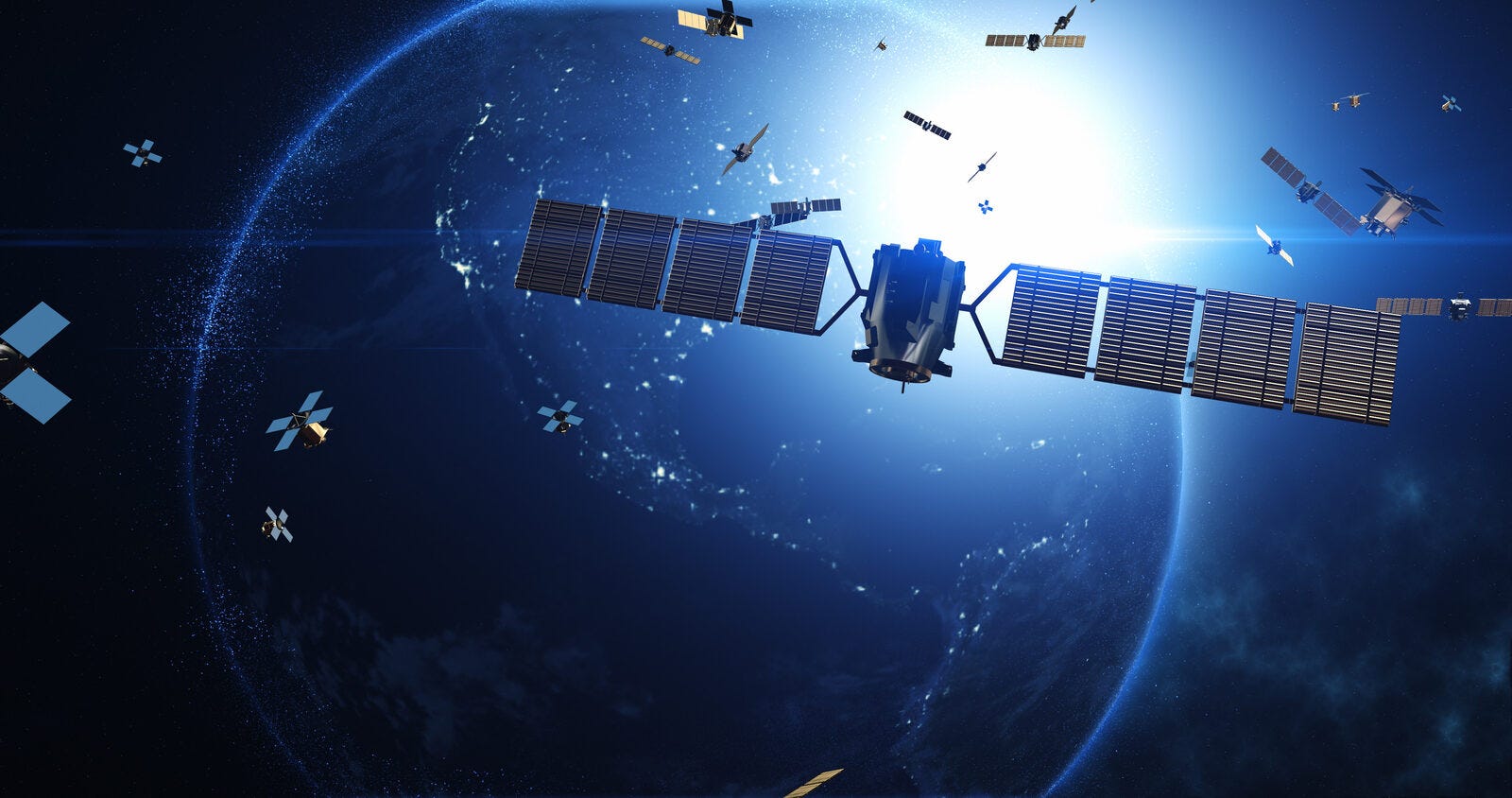
If grid access delays and local opposition are the two defining problems for data centers on the ground, neither one exists in space. No grid means no interconnection queue, and there are no neighbors next to a satellite to organize a protest. The US currently has more than 25 gigawatts of data center capacity under construction, and the pace of new grid interconnection approvals can’t keep up with that volume, which is the real bottleneck this industry is running into right now. It’s not surprising that going to orbit is being pitched as a way around it.
The company that stands out here is Starcloud. When I first read that they’d flown a single Nvidia H100 on a 60kg satellite and trained a language model in orbit back in November 2025, I assumed it was little more than a demo. Then the whole space started moving. In January 2026, SpaceX filed with the FCC for a computing-satellite constellation of up to a million units. Two months later at GTC in March, Nvidia unveiled its Space-1 Vera Rubin module and declared orbital computing an official product category. Google is preparing to launch a prototype for its Suncatcher project in early 2027. And Starcloud came back into view at the end of that run: on August 21st they raised another $250 million in a Series A extension, bringing their total 2026 raise to $420 million and their valuation to $2.3 billion. Their Series A valuation back in March was $1.1 billion, so that’s more than double in five months. I’ve been looking at venture deals for years, and that pace still catches me off guard every time.
The logic behind going to orbit, or more precisely to low Earth orbit (LEO), starts with physics. In space, without atmospheric attenuation, solar intensity holds steady at 1,361 watts per square meter, and a dawn-dusk sun-synchronous orbit keeps a satellite almost entirely out of Earth’s shadow. Ground-based solar capacity factors in the US top out around 25% because the sun rises and sets, but in LEO you get nearly uninterrupted sunlight around the clock. That’s the premise the whole industry is built on: that this can function as baseload power.
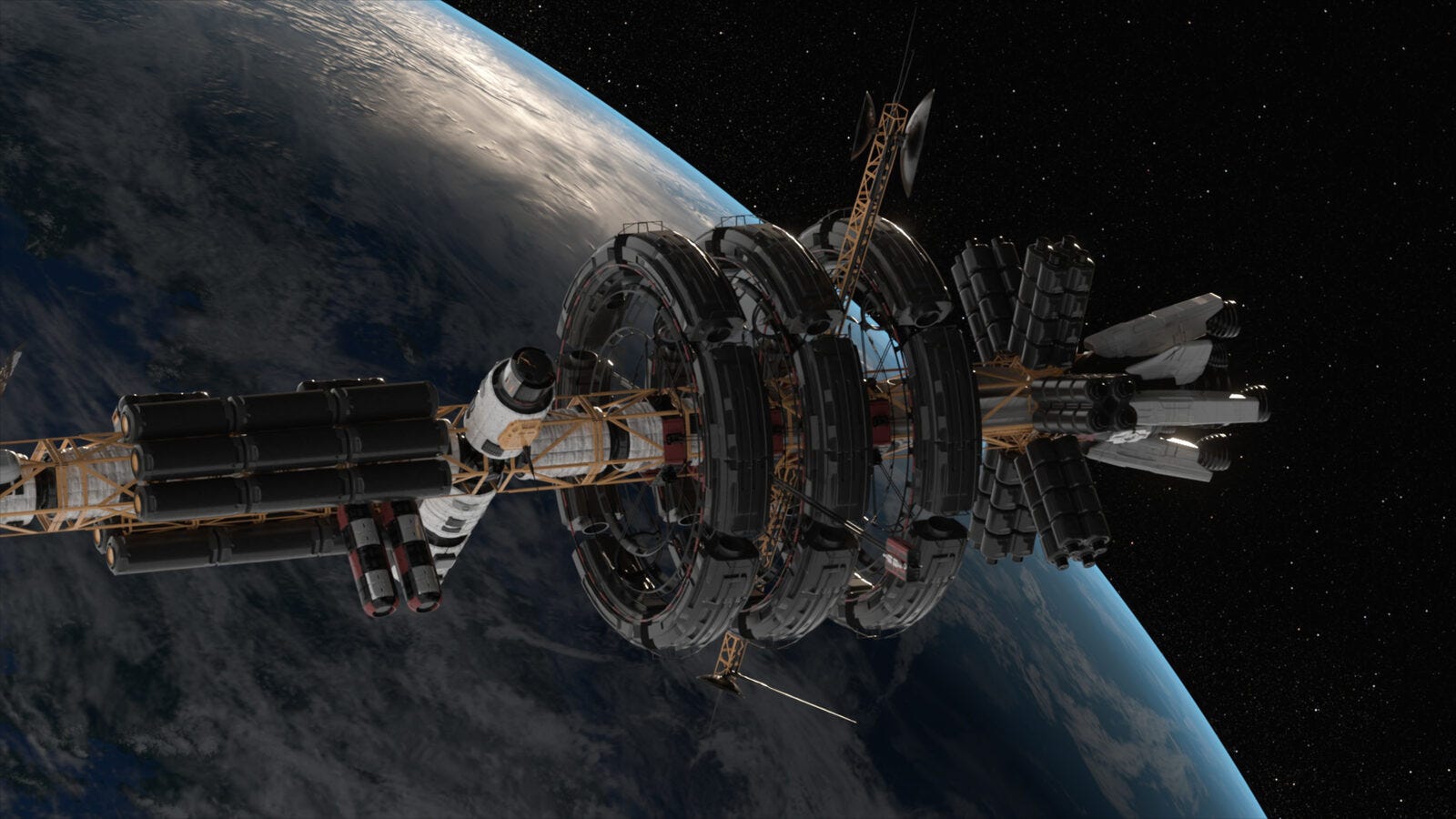
But nothing is ever really free, and this premise comes with new costs that don’t exist on the ground. There’s mass cost, since every kilogram of hardware translates directly into launch cost, and there’s thermal cost, since there’s no convection or conduction in a vacuum, so all heat has to be shed by radiation. Radiation turns out to be the more physically stubborn problem of the two.
The Stefan-Boltzmann law says the heat you can shed by radiation scales with the fourth power of absolute temperature (so I’m told), and at 50°C, radiating away 1 megawatt requires roughly 1,200 square meters of radiator panel, about a third of a soccer field. Since radiator area scales with computing power, a lot of people assume there’s a hard ceiling on how much of this you can put in orbit, or that costs balloon past a certain point.
Looking at that number alone, a large orbital data center seems physically impossible. But the systems actually being designed today are a different scale. Starcloud-2’s GPU is built to dissipate 7kW, and the radiator needed at that scale is only 8.4 square meters. The reason this works isn’t that anyone solved the megawatt-scale thermal problem. It’s that the current designs simply avoid that scale altogether.
Radiation exposure follows a similar pattern. Commercial chips can suffer bit flips or permanent damage from cosmic radiation, and the industry has shifted away from radiation-hardened chips that lag five or ten generations behind, toward off-the-shelf commercial chips paired with shielding and software-level error correction instead. Inter-satellite communication involves the same kind of tradeoff. Laser links are theoretically capable of terabit speeds, but they still fall short of what’s needed for large-scale training, which requires hundreds or thousands of GPUs tightly coupled together. That’s why what this industry is selling right now is inference, not training.
Let’s look at the cost side too. According to Gartner, space-grade solar panels cost 1,000 times more than terrestrial ones, orbital satellites have to survive thermal cycling between -173°C and 127°C (100K to 400K), and there’s no way to send a repair crew if something breaks. Even accounting for how expensive the space industry already is, a 1,000x figure is on a different level entirely.
Short-seller Jim Chanos calls it “AI snake oil,” arguing that once you add up launch costs, insurance, redundancy, and radiation-hardening, the total ends up dwarfing whatever you save on terrestrial electricity bills.
Even the industry itself sounds unsure about the cooling problem. At GTC 2026, Nvidia CEO Jensen Huang admitted: “In space there’s no convection, only radiation. How to cool this is still being researched.”
TechCrunch’s February 2026 analysis puts a sharper number on it. A 1-gigawatt orbital data center costs nearly 3x as much overall as an equivalent ground-based facility ($42.4 billion), and the gap widens further when you isolate power alone: annual cost per kilowatt runs $570 to $3,000 on the ground versus up to $14,700 in orbit. At that point, the skepticism starts to feel less like a fringe view and more like the consensus.
But read the skeptics’ language closely and a pattern shows up. Words like “right now,” “within this decade,” and “at scale” are all hedges. They’re not saying it will never work, just that it doesn’t work yet, and that gap is exactly what’s drawing capital in today. There’s already a place where this pencils out: processing satellite imagery, especially SAR (synthetic aperture radar) data, takes about two hours on the ground but only minutes in orbit. For workloads like counterterrorism operations or disaster response, where speed itself carries value, the cost premium stops mattering.
This isn’t a market competing head-on with terrestrial cloud for general-purpose AI training and inference. It’s a narrower, more specialized market where cash flows first. And companies like Aethero, Cosmic Shielding, and Kepler Communications, which sell radiation-hardened components or inter-satellite communication modules rather than complete services, are positioned to benefit regardless of how the broader orbital data center market plays out, as long as it keeps growing. Their bet is that you don’t need to pick the winner if you’re the one selling the picks and shovels. The political bottleneck on the ground plays into this too. That $64 billion in blocked projects doesn’t look like it’s going to resolve easily, and that’s one more reason capital keeps buying into the space option.
To sum it up: the optimists seem focused on the fact that this technology “works” at all in such an extreme environment, while the skeptics are focused on cost efficiency. It sounds like the same conversation, but the two sides are really operating on different scales entirely. The startups in this space are talking about data centers in the thousands of kilowatts, just now reaching 1 megawatt, because that’s as far as the technology has gotten. Meanwhile, the pessimistic scientists and investors in this space are already comparing that to 100-megawatt terrestrial data centers, and concluding that space is tens to hundreds of times more expensive, can’t be cooled properly, and just won’t work. A 100-megawatt comparison, of all things. It makes me wonder if the pessimists are, in their own way, more optimistic than the optimists here, since assuming space data centers will ever compete at that scale is itself a fairly hopeful assumption. Or maybe that’s just me getting ahead of myself.

There’s an irony worth noting. What Starcloud emphasized in its August raise wasn’t technology, it was securing launch capacity. With SpaceX’s Falcon 9 program winding down by 2028, CEO Philip Johnston has said they need to book an enormous volume of launches right now. The entire industry’s economics rest on the story that launch costs will keep falling over time, but what’s actually happening at the moment is a scramble to lock down launch slots, not lower prices. Those are two different problems, and until Starship reaches a stable commercial launch cadence, the slot shortage might turn out to be the more immediate constraint.
Whether this ends up as a bubble the skeptics warned about, or quietly takes root starting with defense and intelligence workloads, is still an open question. The real launch of Starcloud-2 and its first commercial customers in orbit, Google Suncatcher’s 2027 prototype, and Starship’s actual launch cadence: those are the three things worth watching next.
Sources: Data Center Watch, “$64 billion of data center projects have been blocked or delayed” / The Register, “Orbital datacenters are a pie-in-the-sky idea: Gartner” (Feb 25, 2026) / Data Center Dynamics, “Plans for space data centers labelled ‘ridiculous,’ ‘AI Snake Oil,’ and ‘peak insanity’” / TechCrunch, “Starcloud raises $250 million for orbital data centers as launch options dry up” (Aug 21, 2026) / SiliconANGLE, “Starcloud raises $250M to build AI data centers in orbit” (Aug 21, 2026) / Payload Space, “Starcloud Raises $170M Series A at $1.1B Valuation” (March 2026) / TechCrunch, “Why the economics of orbital AI are so brutal” (Feb 11, 2026) / Mordor Intelligence, “Synthetic Aperture Radar (SAR) Market”