


These days, funding rounds for AI startups feel like a rollercoaster—huge, volatile narratives swing between unicorn-scale Series E deals and early-stage teams still struggling to close a Series A. But in the middle of that chaos, something surprising happened in July 2025.
The mere mention of “LegalOn” was enough to pull major investors to the table—no pitch decks, no roadshows needed. SoftBank Vision Fund, Goldman Sachs, Mizuho Bank, and even Mori Hamada & Matsumoto (one of Japan’s Big Four law firms) all jumped in. If you just look at the cap table, it’s like an All-Star roster of the financial world.
So, why the frenzy?
Everyone knows AI is coming for the legal space—contract review, compliance, due diligence, you name it. But LegalOn isn’t just another startup chasing this trend. It’s one of the rare companies that actually makes AI “legal-grade”—compliant, contextual, and painfully detailed. And more impressively, it’s a homegrown Asian startup from Tokyo that's expanding fast into the US and Europe.
This begs the question: What is LegalOn, really? And why is now the time to pay attention?
Let’s dig in.
LegalOn = Lawyer-Friendly AI
At its core, LegalOn is known for a product called Review—a contract analysis platform powered by AI, but built with legal precision. The name is unambiguous, and the functionality is even more so. Unlike generic LLM-powered tools that return vague warnings—("Here’s something that might be risky")—LegalOn tells you exactly what to change and why, based on your corporate compliance standards and real-life best practices authored by experienced lawyers.
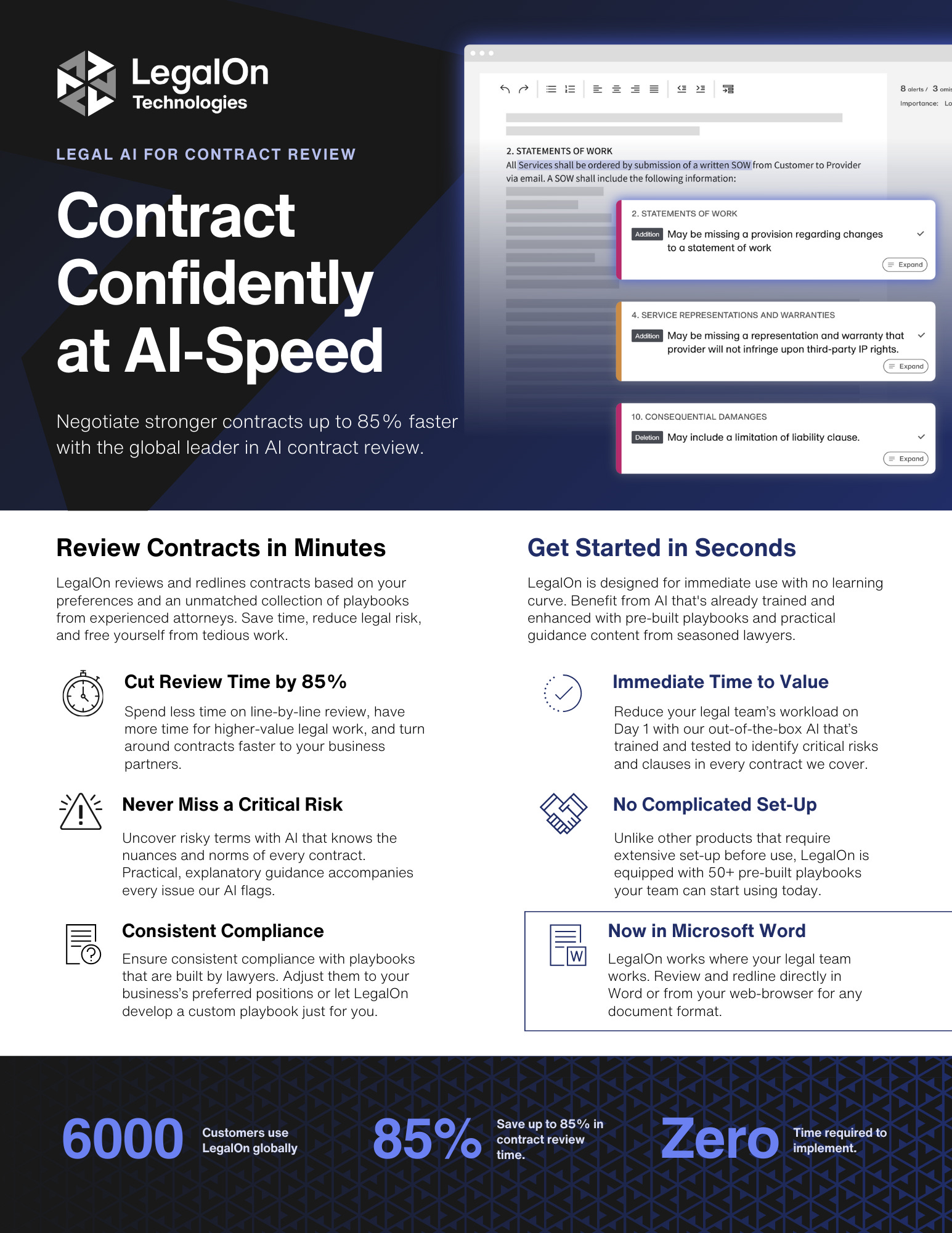
That level of precision is only possible because of one key differentiator: LegalOn is powered by over 50 bespoke “lawyer playbooks.” These aren’t just scripted prompts—they’re operational checklists that in-house counsel actually use, encoded into the model. And it makes sense. Both co-founders, Nozomu Tsunoda and Masataka Ogasawara, come from corporate legal backgrounds. LegalOn isn’t so much a product as it is a digital extension of their years of legal experience.
They’ve also nailed the automation angle. LegalOn can reduce review times by up to 85%, and—crucially—it’s designed so that legal teams can start using it from Day 1. That’s not easy in B2B SaaS. Most enterprise legal teams are terrified of shelfware. But LegalOn can drop into an on-premise-style workflow without disrupting anything.
The results speak volumes: In Japan, over 25% of public institutions already use it. Globally, more than 7,000 organizations are on board. In just the past year, revenue in the UK and US has grown 4x.
Beyond Contracts: AI Agents for Legal Ops
With its recently closed $50M Series C, LegalOn is looking far beyond the legal memo. It’s not content being “just” a contract reviewer.
Enter: Matter Management.
This new feature tackles the workflow before and after a legal document even enters the pipeline—tracking contract requests, assigning internal owners, linking documents together—all within the same interface.
And then came the masterstroke.

LegalOn announced a non-equity strategic partnership with OpenAI. This is not just an API hook-up. Their engineers are working directly with OpenAI’s technical team, giving LegalOn privileged access to the latest GPT models and the inside track on implementation strategies.
They’re not just using GPT—they’re customizing it deeply for a legal domain. LegalOn might become the first AI tool truly optimized for legal teams, from input to interface to inference.
As CEO Daniel Lewis put it: “We’re not training our AI on generic internet data. We’re training it on law firm-grade playbooks written by practicing attorneys. That changes everything.”
If Harvey and Clio proved you could raise massive checks with “Generative AI meets vertical SaaS,” then LegalOn takes it a step further: LegalTech + Lawyer-founders + Japanese execution quality + global expansion mode. It’s a rare mix.
Human-First, AI-Assisted Law
But here's what really earns respect from legal professionals—and VCs.
LegalOn is unapologetically "lawyer-in-the-loop." It's not pretending to replace lawyers. It understands the deeply contextual, nuanced, and organizational nature of legal judgment. Instead, its AI drafts with speed and accuracy, but hands off the final call to a human.
That’s not a flaw—it’s the feature.
The legal industry doesn’t need a judge in the cloud. It needs an intelligent, compliant assistant. LegalOn delivers exactly that, and by shouldering the repetitive grunt work, allows legal professionals to focus on where their expertise actually matters—judgment, strategy, negotiation.
It’s a turning point. Legal teams using LegalOn aren’t just faster—they’re operationally sharper. Cost-effective. Scalable. Error-resilient.
And here’s the real takeaway for investors:
LegalOn is not just another doc automation startup.
It’s the archetype of what vertical SaaS in the AI era should look like:
- Deep industry expertise
- Customized large language models
- Founders who were operators
- Japan-based roots + global ambition
With over $200M already raised from names like SoftBank, Goldman, MUFG, and JAFCO, this is no longer a high-risk bet. Risk’s been priced in. Now the question becomes: how much of the US LegalTech market can they grab?
The AI moment in legal isn’t coming—it’s here. And LegalOn might be the first startup proving that AI can deliver not just speed, but full-stack operational improvement in one of the slowest-moving industries on earth.
This isn’t some greenfield idea. This is execution-first Legal AI.
And if I were a VC reading this?
I’d be dropping a link to this in the company Slack right now.