

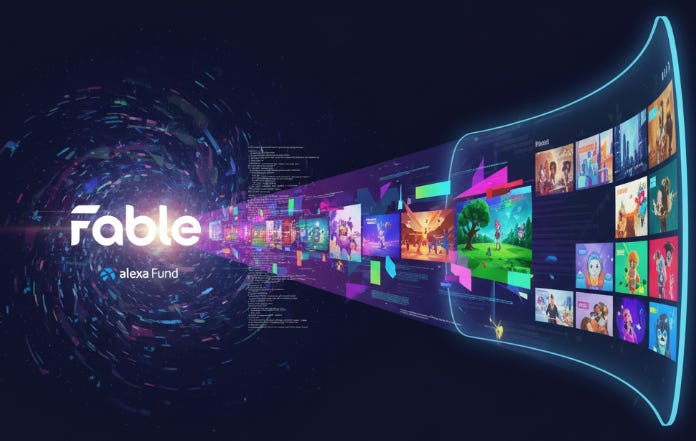
There’s a new startup gaining traction in the AI industry, branding itself as the "Netflix of AI." It's called Fable. The name might evoke a wistful tale or a bedtime story, but make no mistake—this is a bold, ambitious tech startup. They recently secured backing from Amazon’s Alexa Fund and are quickly making headlines with a generative AI platform that can produce entire animated videos based solely on prompts.
But recently, Fable announced a project so eccentric and audacious that it stopped many industry watchers in their tracks: using AI to reconstruct the missing 43 minutes of Orson Welles’ legendary film, The Magnificent Ambersons (1942). And here’s the kicker: they’re doing it without owning the rights to the film—or any formal approval from Welles’ estate.
Fable: From Cartoon Studio to Cinematic Resurrection
Fable initially built its reputation as an AI content engine—think of it as a “creative Lego toolkit,” letting users produce animated stories with AI support, even generating unauthorized episodes in the style of South Park as experimental showcases. The Ambersons project, however, marks something of a pivot. It serves as a technology demonstration for Fable’s new large language and multimodal models, capable of generating sophisticated narratives.
Filmmaker Brian Rose, who has spent the last five years working on digital restoration, is leading this initiative. The technological approach includes:
1) blending AI with live-action footage—casting contemporary actors to reenact missing scenes and digitally replacing their faces with those of the original cast,
2) reconstructing iconic sequences—such as Welles’ famous 4-minute tracking shot—with painstaking precision,
3) proceeding without securing the copyright or even attempting to notify the Welles estate.
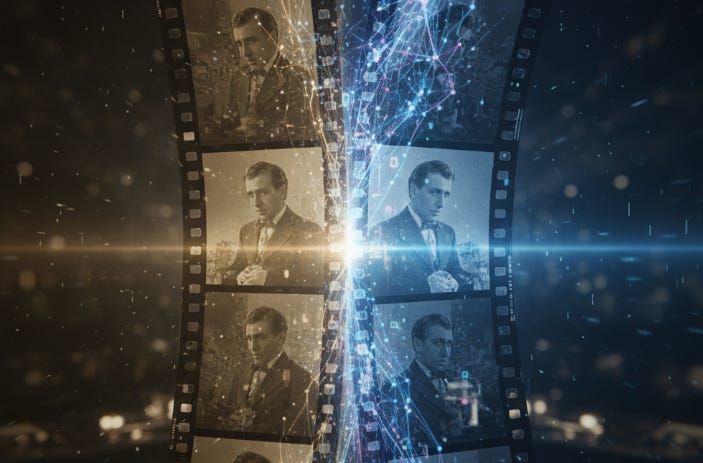
Reading all this, one can’t help but sigh. While “reviving dead art with AI” sounds noble in theory, in practice we may be left with a digital puppet show—a simulation that strips away the creative nuances Welles once infused into every frame: his framing, rhythm, tonal direction, and the subtle inflections of his actors. The Welles family, surprisingly, wasn’t outraged by the act itself, but rather by the complete lack of communication. In fact, Welles’ daughter has already ventured into the commercialization of AI voice models, suggesting the debate isn’t simply a matter of “AI = evil.”
Romance or Illusion? The Limits of AI Artistic Restoration
To give credit where it’s due, Fable’s endeavor does have its allure. In Korea, for instance, one might imagine lost footage or rare archival materials being reconstructed with AI—possibly giving closure to long-time fans and historians. In music, we've already seen similar experiments: AI-generated "new" songs by The Beatles or synthetic recreations of Frank Sinatra’s voice.
But these efforts, however technologically impressive, can never fully recapture an artist’s original brilliance. Physical constraints—like the acoustics of a recording space, the accidental shake of a hand-held camera, the subtle squint of an actor’s eye—are part of what gives authentic art its irreplaceable character. The irony of reviving Ambersons is that its status as “the greatest lost masterpiece in film history” is rooted in these very gaps. It is the impossibility of completion that has given it mythic status. No matter how refined, what Fable is creating isn’t Welles’ Magnificent Ambersons—it’s an AI-generated reinterpretation.
Industry Implications: The Collision of IP, AI, and Creativity
This also raises pressing questions about IP and authorship. The paradox of Fable’s approach is this: in a future where every IP becomes just another training dataset for generative models, the unique voice of the creator risks being drowned out. Control shifts from storytellers to platform giants—Amazon, Google, and their ilk.
This case is a litmus test for how technological innovation will continue to blur the boundaries between creation and replication. Fable’s project sparks not only fascination but a deeper debate: how far is too far when it comes to recreating—or fabricating—the legacy of artistic works with AI? As generative models grow more potent, these questions will only gain urgency, especially in a world where Hollywood and Korea’s content wars are increasingly intertwined.
The Future of Art, or Just Another Disruption?
We’re entering an era in which the ghosts of art may be resurrected by machines—and that demands a reevaluation of what creativity truly means. Where is the line between homage and appropriation? Between restoration and reinvention?
Let’s be very clear: the lost 43 minutes of Ambersons will always belong to Welles. The 43 minutes that AI reconstructs, however, do not. This may become the defining landscape of our time—a world where human tragedy, technological flourish, and enduring questions about originality all coexist, uneasily, within the frame.
As an investor and observer of the AI and creative tech space, I can’t help but watch with cautious optimism. But I’m also reminded that while technology can enhance art, it should never pretend to replace the soul that made it real in the first place.